edora: an AI-assisted exam analytics platform, built solo
I'm a teacher. Every few weeks my students took mock exams, and the results ended up on paper in a drawer. In February 2026 I started building the tool I wanted as a teacher. It has been live since 2026, used by school staff and students.
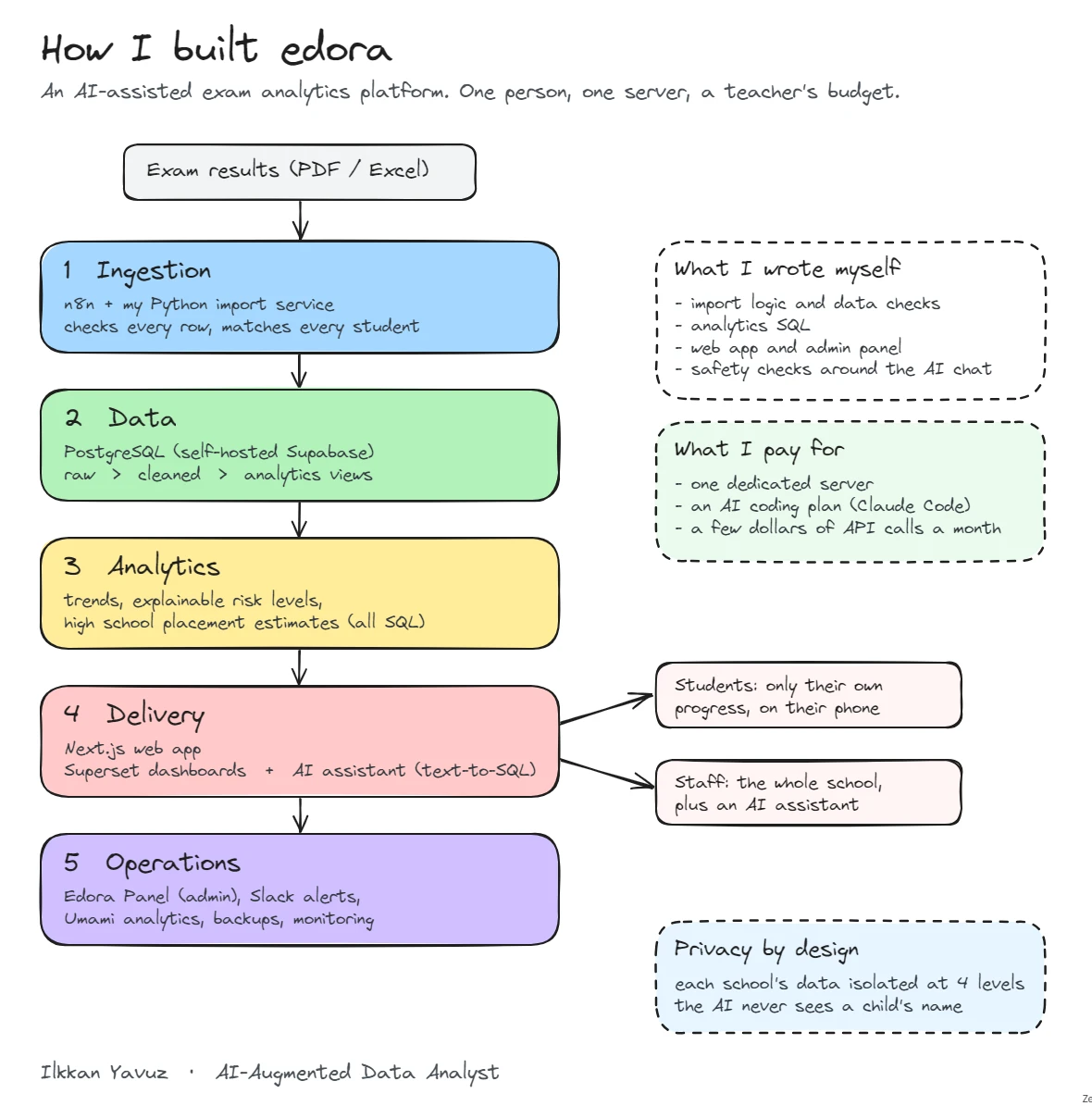
What it does
A school uploads its exam results, and that's all anyone has to do. A few seconds later the results are matched to the right students and every chart is up to date.
Students see only their own data: scores across every exam, how each subject is trending, their rank, and an estimate of which high schools their current scores could get them into. Staff see the whole school, compare classes, spot who needs attention early, and print a one-page report card at the end of each term. They can also ask the data questions in plain language.
I run everything through an admin panel I built for it. Every change shows a preview first and needs a one-time code to confirm, and every action is logged. The same panel is a tool my AI assistant can use through MCP, without a delete command.
From a messy PDF to clean rows
Every publisher has its own PDF layout, so most of the work in this layer is deciding when the data can be trusted.
- n8n notices a new file and sends it to my Python import service.
- LlamaParse turns the PDF into a table.
- The service recognizes the layout by where the required columns sit. For unknown headers it checks a dictionary I built, then asks an LLM using a masked sample, so the model never sees a child's name. A new layout waits for my approval.
- Every row is checked by recalculating the net score (
net = correct − wrong/3). If fewer than 80% of rows pass, the whole file is rejected. - Rows are matched to real students. Uncertain matches are held back for a person to check.
- Results are written and the analytics refresh. I get a Slack summary with how full each column was.
That last check came from a real mistake: one import finished without errors but saved a whole column as empty. A pipeline that fails silently does more damage than one that crashes.
Turning scores into something a teacher can act on
My master's in measurement taught me to read level, direction and consistency together. All of this lives in SQL views, so every number can be traced and explained.
- Trends: a slope per student and subject, reset each school year.
- Risk levels: Normal, Watch or Critical, from recent level, direction and how many subjects are falling. Each label stores its reasons.
- Placement estimate: the last three exams mapped onto the national score distribution, then compared with 584 high school programs and sorted into Safe, Target and Reach.
- Missing isn't zero: a missed exam stays missing and never drags an average down.
Letting staff ask the data a question, safely
The chat is built on an open-source text-to-SQL engine: an LLM writes SQL from the question and the answer comes back with a chart. I had a demo in a day. Making it safe took weeks.
Telling the model to filter by school mostly worked, but not always. So the system enforces it. Before any query runs, my code checks the raw SQL, parses it into a syntax tree, wraps every school table so it can only return the user's own school (taken from the server session), and re-checks the result. Anything unrecognized is rejected. The web app has more than 500 automated tests, many of them on this path.
Cost: don't use an LLM where SQL is enough
I log every free-form question and watch the most repeated ones on a private dashboard. Repeat questions become tested SQL cards that answer instantly at no cost, and a small matcher suggests a card before a question reaches the AI. Free-form questions are capped per person and per school each day, and the check fails closed.
How I build with AI
Claude Code writes fast, but I decide what gets built, check what it wrote, and own every mistake. A project wiki with 121 notes and 53 decision records gives both of us the same memory between sessions. Anything that touches student data gets a test first, and database functions are tested in a throwaway PostgreSQL container.
Children's data changes how you build
Most users are 14 years old, so privacy was a design rule from day one: store only what's needed, mask names before any LLM call, keep a map of where data flows, isolate each school at four separate levels, give every part of the system the least privilege it needs, and keep admin tools off the public internet.
What I learned
- Security comes first. I question every permission and every tool, including the AI I work with.
- More charts don't mean more insight. If nobody would act differently after seeing a chart, it goes.
- AI writes the code, and I still have to think. Judgment is the skill I work on most now.
- Every dollar counts. Open source, self-hosting and plain SQL kept the whole thing affordable.
What's next
Extending it to the university entrance exam, adding short written reports after each exam, and a weekly analytics summary written by an AI agent.
edora is live. Its product site, written for schools, is at edora.dev.
I'm looking for a full-time data analyst or AI analyst role on a team, in Europe or North America.
If you're working on data and AI problems, I'd love to talk: info@ilkkanyavuz.com · LinkedIn